
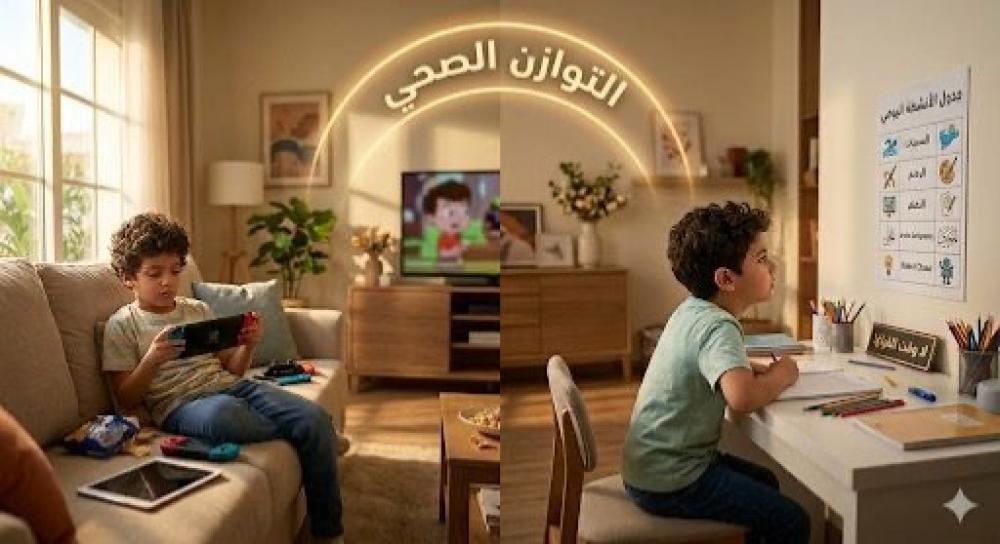
In the same neighborhood, two children experienced their summer vacation in two different ways.
Khaled would wake up late, eat his breakfast in front of the screen, and then switch between games and videos for hours. Whenever he was asked, "What are you going to do today?" he would reply, "I don't know... I'm bored."
As for Omar, his days were packed with courses, activities, and exercises. Even playtime became a regular part of his daily schedule. He no longer complained about having free time, but he began to complain about fatigue, stress, and the fear of falling short.
Khaled's father thought he was giving his son freedom, while Omar's father thought he was raising a successful child. But the truth is, both of them strayed from the necessary balance.
A child who spends his vacation without a goal or guidance may lose many of his habits and skills, and a child who lives under the pressure of continuous activities may lose the joy of childhood and his psychological comfort, and may suffer from anxiety related to achievement and the continuous pursuit of excellence.
Vacation is not a complete void, nor is it an intensive project to accomplish; it is a space for balanced growth.
Why does complete emptiness cause a problem for a child?
Rest after a long school year is essential, but rest doesn't mean spending weeks in bed in front of a screen. A child whose days are devoid of meaningful activities or simple responsibilities becomes accustomed to consumption rather than participation, experience, and learning. Over time, returning to discipline and commitment becomes increasingly difficult.
The problem is not in comfort, but in it becoming a lifestyle that the child gets used to, causing him to lose his passion for work, learning, and initiative.
Does keeping a child busy with activities create success or anxiety?
Conversely, some families view vacation as an opportunity to be fully utilized, filling their children's days with programs and courses, leaving them with little free time. While this may seem like an achievement at first glance, it can turn vacation into a continuous race.
Over time, the child loses their enthusiasm for learning because every activity becomes a new chore. This sometimes manifests as constant complaining, refusal to participate in activities, anxiety about failure, or a loss of passion.
Some parents do not realize that these behaviors are not always spoiled or an escape from responsibility, but may be a sign of exhaustion resulting from the many demands, competition, comparisons and successive goals.
It is true that a child needs opportunities to learn, but he also needs time to be calm, rest and catch his breath.
How do you know you're going in the right direction?
Ask yourself:
Does my child have time for free play?
Play develops creativity, thinking, and problem-solving skills.
Does he have enough time to rest and pursue his hobbies?
Vacation is meant to renew energy, not to replace the pressure of studying with another pressure.
Are the activities suitable for his needs and interests?
Or is it a reflection of the ambitions of adults or of comparisons with others?
Does he seem happy and curious?
Or have tension and discontent become the dominant characteristics?
What is a balanced vacation?
A healthy vacation is like a complete meal:
Relaxation, free play, family time, useful activity, and age-appropriate responsibilities.
A child doesn't need to be busy all the time, nor does he need to be lost all the time, but rather he needs to balance the two.
to remember
Years later, your son will not remember how many courses he attended or how many hours he spent in front of the screen, but he will remember how he felt on that vacation.
Did he live his childhood?
Did he find time to play and explore?
Did he feel close to his family?
A successful vacation is not one that fills a child's time completely, nor one that leaves them completely idle, but rather one from which they return more relaxed and mature, closer to their family, and still retaining their love of learning and passion for discovery.