
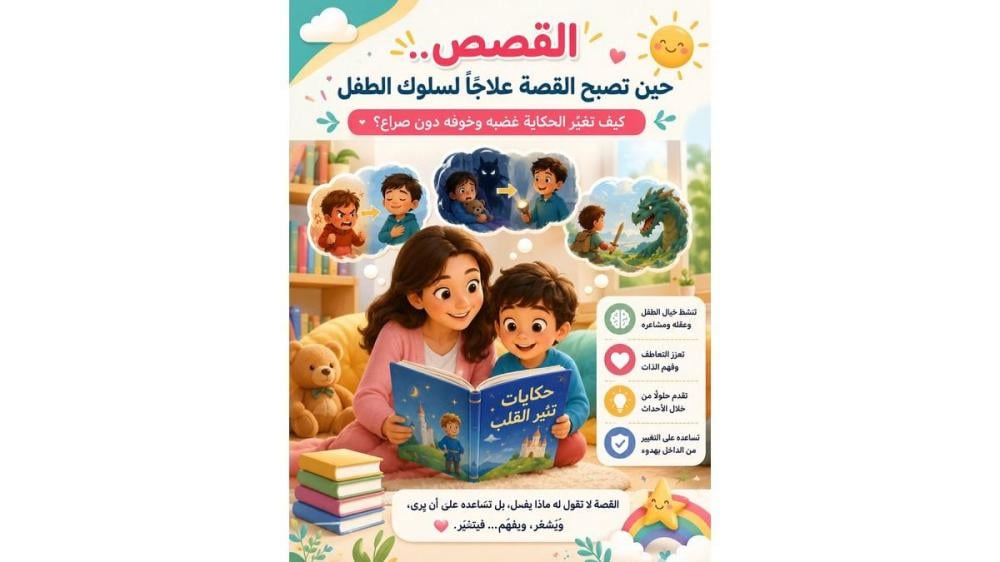
Storytelling is not just entertainment; it's a key to understanding a child's feelings and calmly modifying their behavior. So how can a story change their anger and fear without conflict?
Why does the child listen to the story but refuse direct instruction?
Why is he more influenced by a fictional character than by our words and advice?
Because a child is not a small adult, but rather a being whose cognitive, neurological, and emotional development is still ongoing. The story does not blame or criticize him, but rather enters his inner world, allowing him to interact with and be influenced by its events and characters.
In educational psychology, storytelling is no longer merely a means of entertainment; it has become a tool for understanding the child and shaping their emotions. It doesn't tell them what to do, but rather helps them see, feel, and understand.
Recent studies indicate that storytelling activates multiple areas of the brain, particularly those associated with mental imagery, imagination, and emotions. It also contributes to the release of neurochemicals linked to pleasure, attention, and empathy, making children more receptive to listening and new ideas.
In contrast, direct instruction relies on commands, prohibitions, and abstract rules, such as "Tidy up your toys" or "Don't lie." While such instructions are sometimes important, children may perceive them as criticism, blame, or an attempt to control them, leading to resistance, defiance, or a shutdown of their attention.
The story, however, gives him a safe space for reflection. He does not feel accused or required to defend himself, but rather sits in the seat of the "safe observer" who follows events and reacts to them without pressure.
When we tell a child, "Don't be angry" or "Don't be stubborn," we are directly directing their behavior, and they may feel criticized. However, when we tell a story about a child who is angry or stubborn, we give them a chance to see themselves in a mirror without feeling targeted. This allows them to empathize, reflect, and begin to change from within.
When he listens to the story of another child who got angry because he lost his toy and then learned to calm down or express his feelings in words, he begins to realize that anger is a natural feeling, but the way of expressing it can be learned and developed.
When he hears a story about a child who is afraid of the dark and then gradually confronts his fear, he feels that he is not alone, and that what he is going through is understandable and common among many children.
In situations of rejection or aggressive behavior, the story helps him see the consequences of different actions through events and characters, without direct preaching or confrontation that might push him to resist.
The child becomes attached to fictional characters (such as the evil witch, the scary dragon, or the brave little hero) because they represent a projection of internal conflicts:
Seeing the villain defeated in the story reassures the child that their inner fears can be controlled and defeated in reality.
Seeing a weak person triumph through their intelligence gives them hope and reinforces their concept of self-efficacy.
The story here does not directly address the behavior, but it changes the way the child sees himself and those around him, helps him understand his feelings, reads the situations around him more consciously, and gives him ready-made solutions.
In early and middle childhood, a child believes that everything around them has a soul and life; a toy cries, a tree feels, and an animal speaks. This "animistic thinking" makes the imaginary creatures in stories very real in their consciousness, and they find no logical contradiction in a rabbit advising a fox; rather, they see them as equals and friends who understand their world.
This is why storytelling has always been one of the most influential educational and therapeutic tools; it reaches the child’s heart first, and when the meaning reaches the heart, the change becomes deeper and more lasting.
Tim's tips - Are you always angry?