
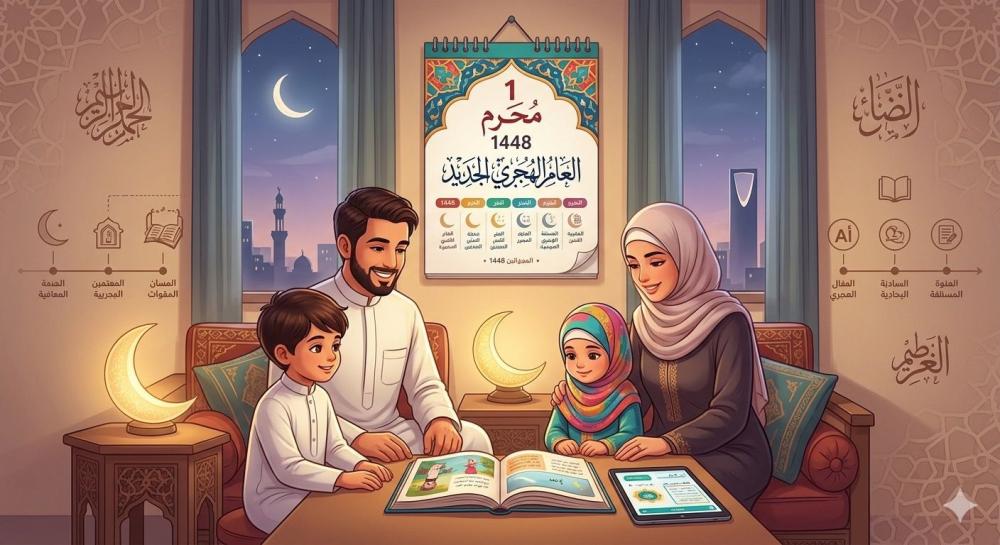
With the first of Muharram and the beginning of our new Hijri year 1448 AH, we, as educators, find ourselves at a point that calls for a moment of reflection: How do we invest this happy occasion with our children, both young and old?
The gift of a new year is a great blessing from God, and it can be a wonderful educational opportunity to instill concepts of identity, time, and gratitude in simple and engaging ways. Allow me to suggest some practical and educational ideas that we can share and implement in our homes:
### 1. The story of "history"... How was our own identity born?
History is not a book to be memorized, but an identity we live and cherish. How wonderful it would be to begin our family gathering with an engaging story about the **"secret behind the name of our Hijri calendar"**:
Tell your children that during the reign of Caliph Umar ibn al-Khattab (may God be pleased with him), the Islamic state expanded, and he received many letters without specific dates. He gathered the Companions and said to them, "Establish something for the people to use as a starting point." Ideas arose; some suggested dating from the Prophet's birth (peace and blessings be upon him), others from his mission, and still others from his death. But the wise Companions, led by Umar and Ali ibn Abi Talib (may God be pleased with them both), agreed on a brilliant idea: "Let us begin the Islamic calendar from the Day of the Hijra (migration)," because the Hijra was the event that distinguished truth from falsehood and marked the beginning of our nation.
This is where we come in to recall with them the story of the Prophet Muhammad's migration (peace be upon him) from Mecca to Medina. In doing so, we instill in them the values of resilience and sacrifice for the sake of principle. We teach them that this event heralded a new era of empowerment after hardship, and the beginning of building a strong and cohesive society.
We want the generation to realize that our Islamic calendar is a message of pride in the three components of our identity: **our religion, our language, and our history**.
### 2. Tools suitable for young ages
Presenting information to young children requires age-appropriate tools, such as reading a story about the Islamic months, like " The Story of the Children of the Moon ," or creating a colorful "Islamic Months Chart" with them, reciting their names, and even singing them together so they learn the names sequentially (Muharram, Safar, Rabi' al-Awwal, etc.). (Story and song: The Time Series )
We can also **link the months to cherished occasions**, to teach them the most important milestones of the year, such as: *"In Rabi' al-Awwal we remember the birth of our Prophet and his great migration, in Ramadan we fast together, and in Dhu al-Hijjah comes Eid al-Adha and we see the pilgrims"*. This connection makes the calendar vivid and joyful in their memory.
### 3. Deepening the understanding of concepts with older children
As for our older children, we delve deeper into thinking about this occasion; so that the new year becomes an opportunity to instill the concept of **"time as a blessing"**, and to train them to remember blessings in detail, and to fill their hearts with acknowledging and talking about them.
Let us teach our children that gratitude is not expressed only through words, but also through practical gratitude.
We can also reflect with them on the fact that God Almighty has given us the opportunity to live a new year, and this is one of the greatest blessings that requires gratitude, reflection, and planning. Let us hold a simple family planning session in which we set clear goals for good and righteous deeds this year.
### 4. Renewing the covenant and making an impact
Let's share with our children the idea of "renewing our pledge of obedience" and making a positive impact on others. To that end, we can create a "family fund for positive impact," where each member can write down a good deed or act of kindness they have done for others, always remembering the Prophet's saying (peace and blessings be upon him): "The best of people are those who live long and whose deeds are good."
How wonderful it is to reflect with our children on the wisdom of starting with the month of Muharram, which is a sacred month in the sight of God; as if the divine educational message is telling us: *Start your year with piety, staying away from what God has forbidden, and drawing closer to Him*.
Let's ask our children this question: *"What bad habit do we want to give up in the past year to get closer to God? And what new act of obedience do we want to commit to?"*
**A happy and blessed Hijri year, filled with optimism and hope, and the building of a generation that takes pride in its Arab and Islamic identity.**