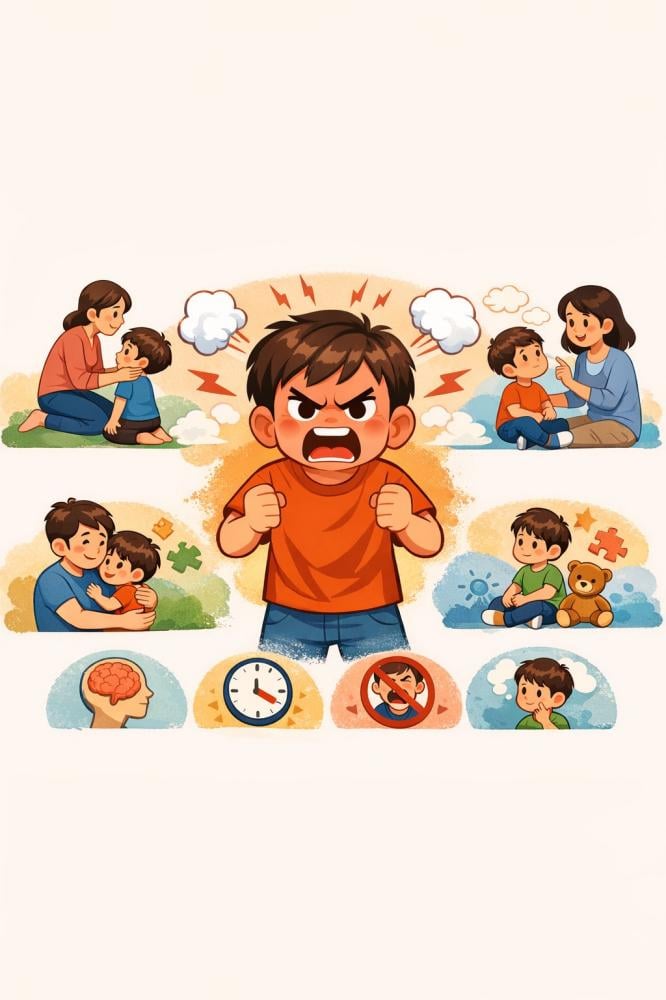
Your child's mood can change in an instant, from laughter to screaming, from quiet play to a tantrum. At that moment, the parent stands perplexed: Should we ignore it? Should we punish it? Should we comfort it? With repeated occurrences, we may feel tired, helpless, or frustrated, especially when the anger becomes frequent or intense.
But before we ask: How do we stop a child's anger? We must first ask: Why does the child get angry in the first place?
Anger, in reality, is not a bad behavior as we might think; rather, it is a natural feeling, a message a child sends when they are unable to express themselves in words. Young children don't always have the ability to say: "I'm upset," "I'm angry," "I feel wronged," "I'm tired," "I'm jealous," "I'm scared," etc. So they express it in their own way: by shouting, crying, refusing, or becoming irritable.
When we understand that anger is a message , our approach to it will change completely. Instead of asking, "How do I calm the child?" we will ask, "What does he want to say?"
Many children get angry because they can't express themselves, because they feel frustrated, because they've lost control of a situation, or because we haven't understood what they want. Therefore, anger isn't the real problem; it's the result . The root cause is an internal feeling the child hasn't been able to articulate.
This is where the role of the educator comes in. Our task is not to prevent the child from getting angry, as this is impossible, but rather to teach him what to do when he gets angry.
Before a child gets angry, we need to talk to them about feelings: What is anger? How do we feel it? What do we do when we are angry? We can teach them this through stories, play, and role-playing, and by teaching them simple phrases to say when they are angry, such as: "I am angry," "I don't like this," "I want to calm down." When we teach a child these things during calm times, they will be able to use them when they are angry.
During a tantrum, it's important to remember that a child at that moment is unable to think or learn because they are under intense emotional pressure. Therefore, excessive talking or scolding at that time is counterproductive and may even worsen the situation. What a child needs most during a tantrum is a calm caregiver , because your calmness helps their nervous system to calm down. Sometimes, simply being near them, sitting beside them, speaking softly, helping them breathe, or giving them a little time to calm down is enough.
After the child calms down, the most important educational moment arrives: the learning moment. Here, we speak to them calmly: What happened? How did you feel? What can we do next time instead of yelling or hitting? When the child succeeds in calming down or trying to control themselves, we should encourage them, because they are learning a difficult skill that takes time.
Always remember: When a child screams and we scream with them, we teach them to scream. When they get angry and we get angry, we teach them to be angry. But when they get angry and we remain calm, we teach them the most important skill in life: how to calm down when they are angry.
Anger is not a problem for which a child should be punished; rather, it is an opportunity to teach them how to understand themselves, how to express their feelings, how to calm down, and how to solve their problems without harming themselves or others. This is a skill that, if learned in childhood, will protect them throughout their lives.
Your child doesn't need you to be perfect.
Rather, he needs you to be calm, steady, and patient…
Because an angry child does not need punishment as much as he needs someone to teach him how to calm down.