
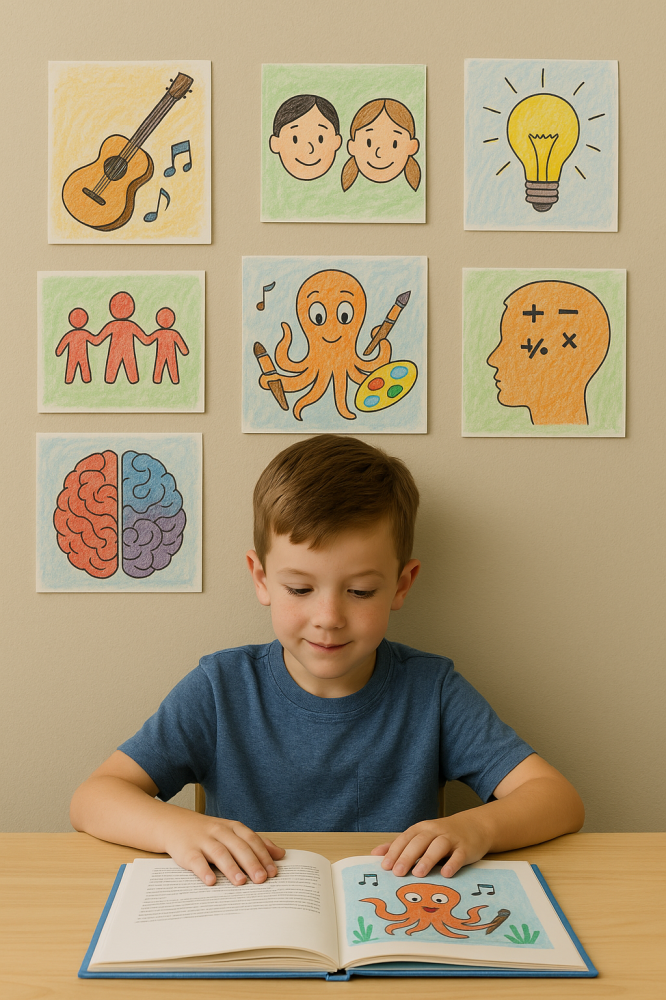
In a world characterized by diversity and differences in individual abilities and learning styles, it is no longer appropriate to adopt a standardized educational approach by which everyone is measured. Here, the theory of multiple intelligences emerges, highlighting that each child possesses a unique pattern of intelligence that distinguishes them from others and deserves to be discovered and developed. The importance of this theory lies in the fields of education and teaching, given its effective and prominent role in empowering children, enhancing their self-confidence, and building a comprehensive educational environment that capitalizes on their diverse talents and directs them toward integrated growth, highlighting their abilities and harnessing them toward a better future.
In this context, traditional academic abilities, such as language and logical skills, have long been considered the sole standard for assessing children's intelligence, marginalizing other equally important abilities and potentials, such as motor, social, or artistic skills. With the development of modern educational concepts, the need for a broader, more comprehensive view of children's abilities has emerged.
Hence, the theory of multiple intelligences has reshaped the educational process. It believes that each child possesses a unique pattern of intelligence, whether linguistic, logical, musical, visual, physical, or even social and interpersonal. This deep understanding of the nature of intelligence provides educators with stronger tools for understanding children and provides them with flexible and personalized educational opportunities. This contributes to raising children's academic achievement, strengthening their relationship with their learning environment, and enhancing their self-confidence.
Based on the above, we can ask: How can parents and educators support their children's multiple intelligences and employ them in the learning environment?
- Uncovering True Potential: Multiple intelligences help us transcend narrow categories. Your child may not be a math genius, but they may be creative in drawing, a natural leader in interacting with their peers, or have a keen sense of music. This theory encourages us to celebrate all these talents and treat them as significant achievements, which boosts the child's self-confidence and helps them realize their unique value.
- Promoting personalized and effective learning: When we understand a child's dominant intelligence, we can tailor teaching methods to suit them. Someone who learns best through movement and touch (kinesthetic intelligence) differs from someone who prefers listening and discussion (linguistic intelligence). This customization makes the learning process more enjoyable and effective, and ensures that information is delivered in a way that suits the child's mindset.
- Building a well-rounded and flexible personality: Focusing on a single type of intelligence may neglect important aspects of a child's development. Hence, the theory of multiple intelligences calls for developing all aspects: emotional, social, creative, and logical. This holistic approach creates more balanced and adaptable personalities, ready to face life's complex challenges.
- Expanding horizons for professional and personal success: Today's world requires diverse skills, such as the ability to communicate, lead, be creative, solve problems, and even understand oneself and others. These skills have become no less important than academic skills. When we develop our children's multiple intelligences, we prepare them for a promising future, whether in the fields of arts, technology, entrepreneurship, or whatever path they choose.
- Stories: They are an easy and clear tool for introducing the concept of intelligence to children in a simplified and endearing way. Stories are an exceptional educational tool for supporting these intelligences. They not only provide information, but also instill values and develop skills in an indirect and enjoyable way. Most importantly, they provide mothers and teachers with an easy and clear way to introduce the concept of multiple intelligences to the child himself, in a way that matches his understanding and captures his interest.
Within this framework, the " Mr. Octopus " story series offers a unique approach to discovering and developing these intelligences in a practical and entertaining way. Each story in this series focuses on a specific aspect, providing children with models and adventures that stimulate their various intelligences:
- Artistic and Musical Intelligence: Through stories that include music, colors, shapes, and aesthetic sense, children learn to appreciate the arts and stimulate their artistic and musical intelligence.
- Social Intelligence: The stories in this series demonstrate the importance of interacting with others, promote friendship building, and support the resolution of conflicts in a friendly manner, which enhances the child's social intelligence and ability to cooperate.
- Creative (or visual-spatial) intelligence: Some stories present challenges that require thinking outside the box, designing things, or solving spatial puzzles, which develops creative intelligence and the ability to innovate.
- Logical-mathematical intelligence: Stories present situations that require logical thinking and solving numerical or logical problems, which strengthens their mathematical intelligence.
In conclusion, multiple intelligences remain a gateway to a deeper understanding of our children's abilities and learning needs. It is a call to reconsider our educational approaches, giving each child the space they deserve to grow and shine according to their unique nature. Investing in developing these intelligences is not an option; it is a necessity for creating a creative, balanced, and confident generation. Let us transcend the traditional view of intelligence and celebrate each unique talent in our children, building a confident, creative generation capable of achieving their full potential.