
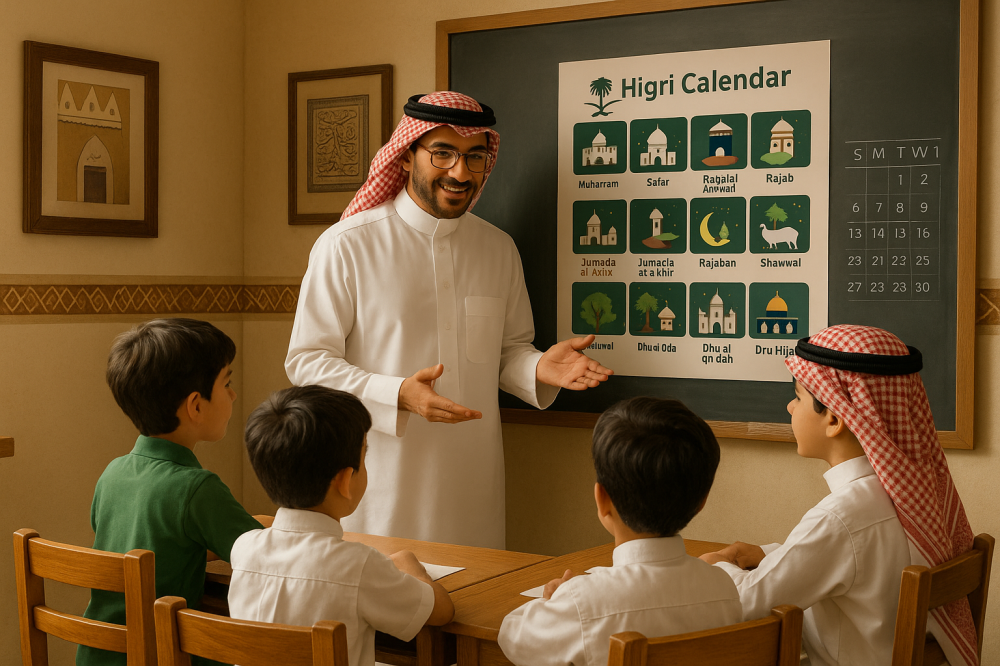
With the beginning of the new Hijri year, as we congratulate each other on its arrival, let us think and ask ourselves: How interested are our youth and children in this occasion? Do we work to involve them in this congratulation, and teach them what kind of calendar it is? Do we make sure to teach them the months of the lunar year, and convey to them the stories of the predecessors related to it?
We know that the Islamic calendar, with its lunar months, is the identity of Muslims. Therefore, teaching it to its followers is an indispensable duty, as it is linked to acts of worship, seasons of devotion, and Muslim holidays. Some might argue that the entire world today operates on the Gregorian calendar and that we cannot do without it. Indeed, we cannot do without either. God Almighty says, "It is He who made the sun a shining light and the moon a reflected light and determined for it phases - that you may know the number of years and the account [of time]. God did not create this except in truth. He details the signs for a people who know." When we contemplate this noble verse, we find that God has made the sun and the moon subservient to us so that we may know the number of years and the account [of time], and so that we may calculate our days, months, and seasons, and so that the instruments by which we measure time may be precise and accurate. The sun and the moon move through this universe in their constellations and phases with precise and meticulous calculation and predetermined measure, out of mercy and care for His servants. Without their running being marred by disruption or disturbance, and if we look for the meaning of the calendar in the dictionary, we will find that it means, technically: an organization for measuring time and it depends on recurring natural phenomena such as the cycles of the sun and moon and the four seasons. So there are two calendars of time: the solar calendar and the lunar calendar. Since the solar calendar is relatively fixed, the seasons of study and agriculture depend on it, while the lunar calendar is how we follow religious occasions such as the arrival of the month of Ramadan, the Hajj season and the holidays, and we also know the sacred months. Thus, people know the years, months, days and seasons and know the months of Hajj and fasting and other matters of life.
The two calendars are mentioned in Surah Al-Kahf to tell us precisely how long the People of the Cave stayed there. God Almighty said: “And they remained in their cave for three hundred years and added nine.” (Verse 25, Surah Al-Kahf)
It was mentioned in Ibn Kathir’s interpretation that these numbers indicate the difference between the lunar and solar calendars. The amount of time they stayed was three hundred solar years and nine lunar years, and this is one of the miracles of the Qur’an.
In our time, we find that it is necessary for our children to master more than one language, so we must make sure that they deal with the lunar and solar calendars and call them by their original names, so that one calendar does not disappear at the expense of the other.
O Allah, teach us what benefits us, and make us benefit from what You have taught us, and increase us in knowledge.