
Problem-solving skills are no longer just an added bonus, especially in today's rapidly changing world. They have become a necessity for our children's growth and future success. It's not just about "solving" problems, but also about addressing their root causes and providing sustainable solutions.
This skill is considered a broad umbrella that includes critical thinking, creativity, flexibility, and adapting to various challenges. It is the foundation that enables a child to understand the world around him, make sound decisions, and also face the obstacles that confront him with confidence and independence.
The fundamental question that arises is: Why has this skill become more important than ever?
Life no longer follows a fixed "instruction book." Rather, it requires flexible thinking and the ability to adapt to new and unexpected situations. Children who possess this skill will be better able to:
* Self-learning: understanding complex problems in academic subjects and finding innovative ways to solve them.
* Adapting to change: whether it's a change in the school environment, social challenges, or even rapid technological developments.
* Building healthy relationships: This involves resolving conflicts with peers and siblings in constructive and effective ways.
* Achieving professional success: The future job market will later require analytical and creative skills that artificial intelligence alone cannot perform.
Here are some effective ways to teach children problem-solving skills:
The role is no longer limited to “guiding” the child, but rather includes empowering him through a stimulating environment and influential educational experiences, including:
Project-Based Learning (PBL):
This methodology transforms learning into a real-life experience, as children work on realistic projects that require them to identify problems, find solutions, and then implement them.
Example: Instead of studying environmental pollution from a book, a school or even a homework assignment could assign children a project to "reduce plastic waste in the neighborhood." Children would then research the sources of waste, design solutions (such as an awareness campaign or creating toys from recycled plastic), implement them, and evaluate their impact. This would teach them to identify a problem, develop creative thinking, and foster teamwork and perseverance.
Design Thinking:
It is an approach that focuses on understanding the user (in this case, the child himself or herself or those around him), generating ideas, building prototypes, and testing them, which leads to the development of empathy and creativity.
Example: A child is having trouble organizing his scattered toys in the room. Using design thinking, parents can encourage him to:
* Empathy: “Why don’t you like to organize your toys?” (Maybe because the boxes are too big, or he can’t reach them.)
* Define the problem: “How can we make arranging toys easier and more fun for you?”
* Generate ideas: suggest solutions such as: smaller boxes, new shelves, color-coded toys.
* Build a prototype: Test a new box or shelf for a week.
* Test and iterate: “Did this solution work? What can we improve?”
Using stories as an effective means of teaching problem solving:
Stories, especially those of the prophets, are rich in situations that require solutions and thought, and they can be used to develop this skill in an interesting and effective way.
Example: When reading a story, stop at the “cluster” or main problem and ask your child: “What do you expect the hero to do to solve this problem?” or “If you were in his place, what would you do?” After the story ends, you can discuss: “Were there other solutions the hero could have used?”
Stories of the Prophets as a source of inspiration:
* The story of Joseph, peace be upon him: how he dealt with the problem of his brothers’ envy, then the problem of his imprisonment, followed by his dealing with the problem of famine in Egypt. Each of these situations represents a challenge and requires finding creative and logical solutions.
* The story of Moses, peace be upon him: how he confronted Pharaoh and his tyranny, how he dealt with the miracle of parting the sea, and then his people's problem with the calf. These stories demonstrate to children the importance of patience, trust, and thinking of solutions in the most difficult circumstances.
* The story of Noah, peace be upon him: How he dealt with the problem of his people's denial, then built an ark to face the flood. This story highlights the importance of perseverance, planning, and faith in divine solutions.
STEM/STEAM (Science, Technology, Engineering, Arts, Mathematics) Methodology
These curricula focus on connecting subjects to each other and to real-world challenges, encouraging holistic thinking and integrated solutions.
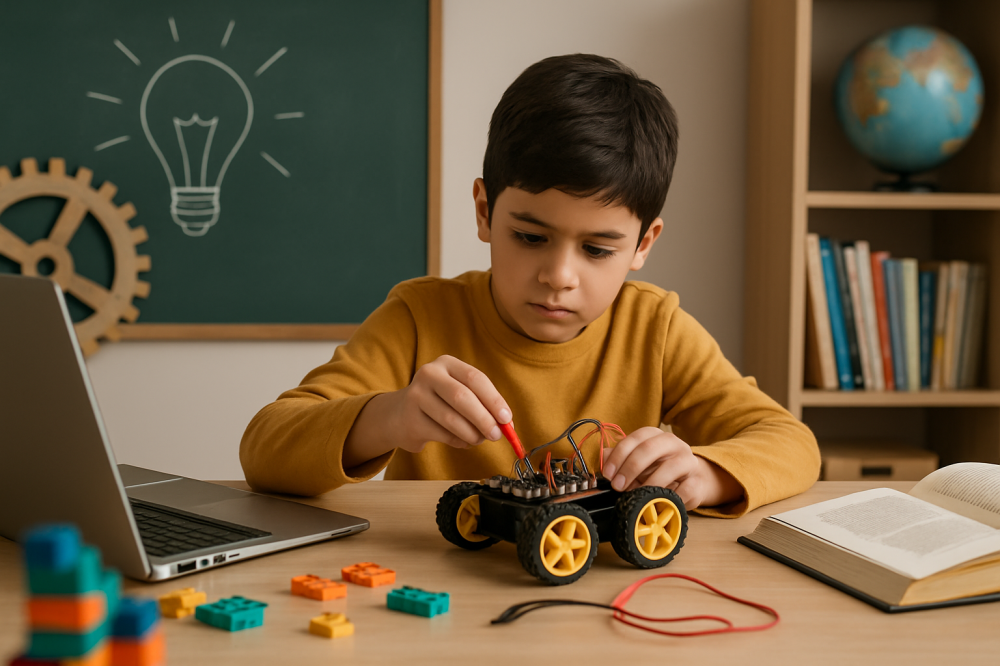
Example: Building a simple robot using available household tools and materials: You will notice how the child will face engineering challenges (how are the parts assembled?), technical (how does the motor work?), mathematical (what is the ideal angle?), and scientific (why does it move this way?). First, if the robot does not succeed, the child will learn to analyze the problem and find different and alternative solutions.
Encouraging “productive failure”:
Instead of fearing failure, children are encouraged to make mistakes and learn from them.
Example: When a child makes a mistake in solving a puzzle or game, instead of giving them the solution directly, we can ask them: “What did you learn from this attempt?” or “What will you do differently next time?” This will teach them that failure is not the end of the road, but rather an opportunity for growth and critical thinking to achieve the goal.
What is the role of parents and teachers?
Our role as adults is not to provide answers, but to provide an environment that allows children to explore, question, experiment, and make mistakes. So, encourage open dialogue and ask open-ended questions (like “What do you think we should do?” or “What if we try this?”). Above all, let your children face simple problems on their own at first, offering support and guidance when needed.
Always remember that our goal is to raise generations who are not afraid of challenges or fear difficulties, but rather see them as opportunities for growth and innovation.