
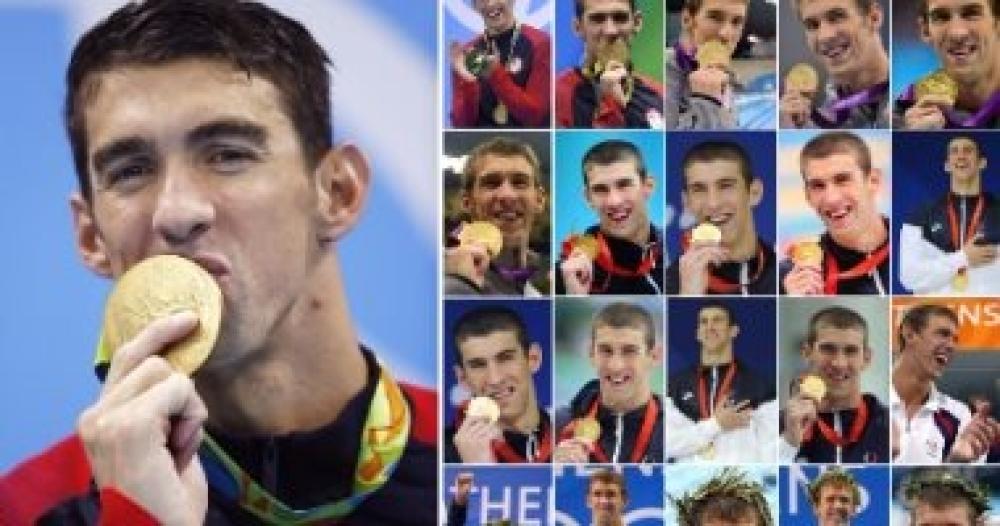
American Michael Phelps (Beijing 2008) has won eight gold medals in a single Olympic Games, breaking seven world records and the record for the most gold medals in a single Olympic Games. The 23-year-old Phelps has now won 14 gold medals, having previously won six gold medals in Athens 2004, breaking another record for the total number of medals won in an Olympic Games. It is worth noting that he trains six days a week for six hours a day, swimming a distance of 20 kilometers per day.
This hero who captured the world’s attention, was talked about in all media outlets with admiration and amazement, became a symbol of excellence, an inspiration for ambition, and a measure of excellence for athletes. His teacher once described him as a failure who was unable to do anything, and predicted that he would not succeed… Michael dedicated this historic achievement to his wonderful mother who understood and supported him. She confronted that teacher, and even the entire society around him, and assured them that he was a different child, and that he only suffered from Attention Deficit Hyperactivity Disorder (ADHD). She would take the initiative and tell them that he needed you; how could you help him?
And it's not just Philip, consider the following list of names:
Jim Carrey, Tom Cruise, Leonardo da Vinci, Van Gogh, Galileo, Michael Jordan, Carl Lewis, Thomas Edison, Albert Einstein, the Wright Brothers, Abraham Lincoln, Mozart, Handel, Elvis Presley, George Bernard Shaw, Alfred Hitchcock, Ernest Hemingway, and many others. It is true that they differ in their interests and professions; some of them are athletes, inventors, actors, artists, musicians, presidents, and writers. However, there are common denominators that unite them. They have all made history, and humanity owes them a debt of gratitude for their great works that are examples of creativity and genius. The biggest surprise is that they also suffer from Autism Spectrum Disorder (AFTA) and Dyslexia.
Approximately 2 to 3 million children worldwide are affected by this disorder. The number of people who have visited doctors for treatment or consultation about the disorder – according to the US Department of Health for 2001 – is estimated at 10 million people. Arab studies in Saudi Arabia and the Emirates have estimated the percentage of those affected at approximately 10% – 18% of school-age children; which means that one child out of every 25 is affected by this disorder. What is frightening is that in 70% of cases, the effects of these symptoms continue to affect them until adulthood.
As you can see, this disorder is widespread, affecting a large percentage of our children. What's even more surprising is that it conceals traits of genius and creativity. This is why we've written about it for the fourth time in the Educational Challenges section, hoping to clarify our vision, contribute to raising public awareness, and change the way we view these children. They're not sick, they're just different. They see the world from a different perspective, and they have a great deal of physical and mental energy that must be invested in achieving many useful things.
Hence, we must treat children accordingly. Why does the nation lose valuable energies due to a lack of awareness and interest?
Published in Teacher's Mail Magazine, Issue No. 57, January 2009