
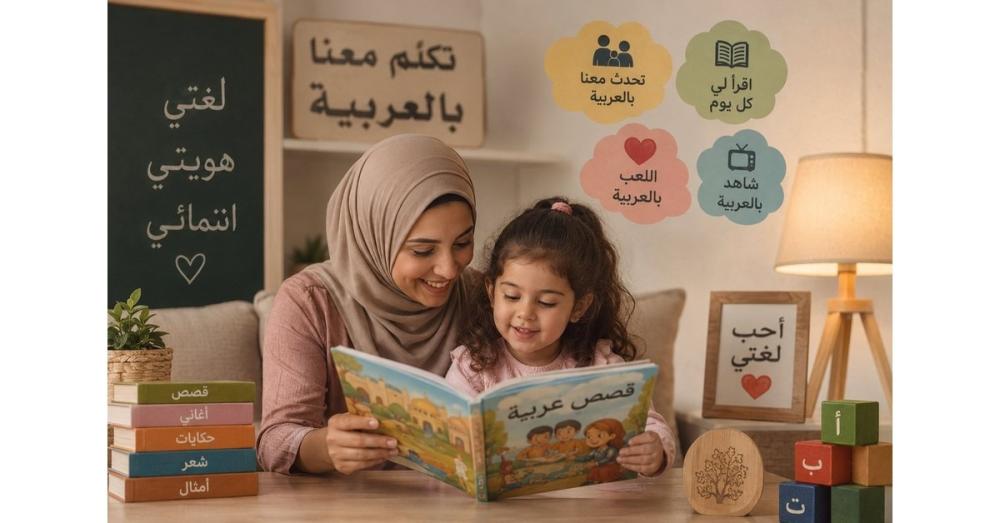
I was surprised by my three-year-old granddaughter's insistence on speaking English when she returned from nursery school. This wasn't her habit before school; she spoke Arabic fluently and spontaneously. What's even stranger is that we are very particular about Arabic at home; we speak it to her, read her stories, sing to her in Arabic, and only respond to her in Arabic. Yet, she sometimes insisted on speaking English.
This puzzled me until one day I took her to the park and found her speaking English with the other children. That's when I realized she had begun to think—with the innocence of her age—that English was "the language of the little ones," because it was the language associated with play, activities, and friends at school.
Then I was even more convinced of it when I attended her graduation ceremony. There, the school principal told the parents:
“You noticed that our entire party was in Arabic, and you saw how your children reacted to it… Please speak to them in Arabic, even if only for a week.”
Her words were short, but profound. Why does an Arabic school need such a plea? It is the language of our children, their identity, their culture. And how has preserving Arabic within homes become such an educational, cultural, and psychological challenge?
That scene opened a wide door for me to reflect on a more serious issue than we imagine: How is linguistic identity formed in the early years? And how can a child lose their emotional connection to their mother tongue without us realizing it?
How is linguistic identity formed between the third and fifth grades?
Psychologists and educators confirm that the period between the ages of three and five is one of the most important stages in the formation of linguistic and psychological identity. During these years, children not only learn words, but also develop a sense of belonging, identify the language they are familiar with, use to express themselves, and feel comfortable listening to.
At this stage, language is not merely a means of communication, but a complete psychological, cultural, and emotional vessel. Therefore, studies confirm that a child with a strong foundation in their mother tongue is later better equipped to learn other languages with greater proficiency, because the mother tongue shapes their thinking, comprehension, analysis, and expression.
When a child's connection to their mother tongue weakens, they may experience a state of limbo; they are neither fully integrated into another culture nor deeply rooted in their own. Over time, they become more vulnerable to imitation and more susceptible to being absorbed by any model they perceive as stronger or more prevalent.
This is why we see many who are raised away from their mother tongue later unable to express their deep feelings to their families, and feel a hidden separation between them and their parents and grandparents; because the deepest human feelings need a language rooted in the conscience, not a borrowed language.
No one opposes learning English; it is the language of science and global communication today, and acquiring it has become a practical necessity. However, it is also a relatively easy language to learn because children are surrounded by it at school, on screens, in games, and on the internet.
Therefore, the correct equation is not: Arabic or English, but:
Strong Arabic first… then any other language after that.
Why is it more serious than we think?
Because a child aged 3-5 years not only learns language, but also internally answers crucial questions:
Who am I?
And to which world do I belong?
What image do I want to project?
If he feels that the “strongest language” is another language, and that his mother tongue is only used for guidance, study and traditional speech, then he psychologically begins to distance himself from it, even if he still understands it.
What does a child lose when they lose their language?
Loses:
His ability to understand his culture deeply.
* His connection to the history, literature, and poetry of his society.
* Part of his self-confidence and identity.
* Easy and genuine communication with his family and grandparents.
* A complete sense of belonging.
What is more dangerous is that he may begin – unconsciously – to feel that everything related to his native language is less valuable or less developed, and thus develops within himself a hidden contempt for his own identity.
What do we lose when Arabic weakens?
Weakness in the Arabic language doesn't just mean weak communication; it also weakens the connection to religion, culture, and identity. How can a child understand the Quran and supplications, and find devotion in prayer, if Arabic is distant from their heart? How can they appreciate the beauty of Arabic poetry, the eloquence of oratory, the splendor of literature, and the richness of meaning that shaped an entire civilization?
And Umar ibn al-Khattab, may God be pleased with him, spoke the truth when he said:
“Learn Arabic, for it is part of your religion.”
He also said:
“Learn Arabic, for it strengthens the mind and increases chivalry.”
What can parents do?
* Speaking Arabic inside the house constantly.
* Read Arabic stories daily.
* Playing Arabic cartoons and programs; because they enrich the linguistic vocabulary in an enjoyable and natural way.
* Link Arabic to play, laughter, and family warmth, not just to commands and studying.
And always remember:
The child does not love the language because it is grammatically correct, but because he feels that it resembles him… and resembles those he loves.