
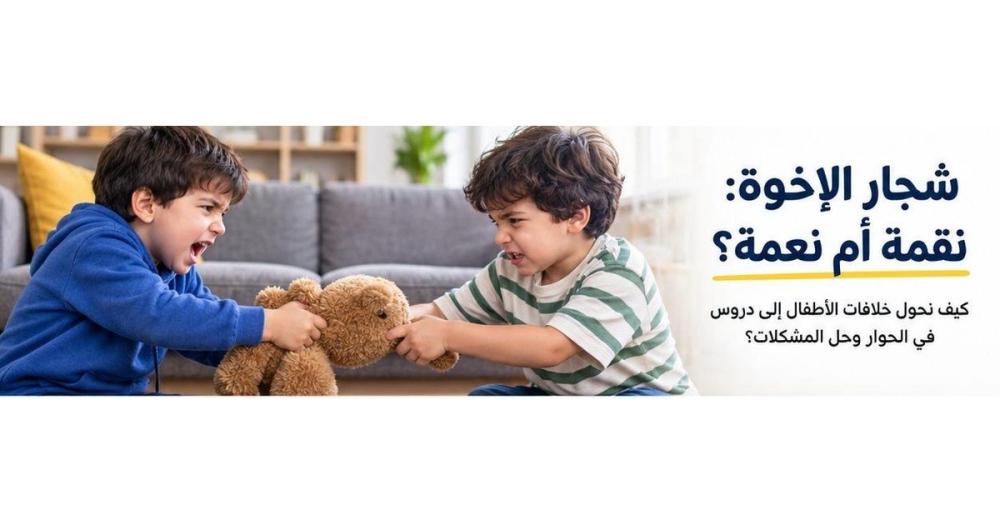
Between the role of "judge" and the role of "facilitator": How can we turn our children's fights into an opportunity for learning and growth?
Imagine this recurring scene: Parents wake up to screams coming from the children's room, a toy being fought over by two children, mutual accusations, and angry tears.
At this moment, many parents feel frustrated, and may be overcome by feelings of guilt or failure in parenting, and may wonder:
Why can't our children live together in peace and tranquility?
But what if we looked at this fight from a different angle?
What if this annoying screaming was, in some situations, the sound of a live social "workshop" where children are practicing some of the most important skills they will need in their lives?
Natural conflicts between siblings are not always a sign of failed parenting; rather, they can be an opportunity to learn to negotiate, express feelings, defend rights, understand others' points of view, and reach common solutions.
This does not mean that fighting is desirable in itself, or that children who communicate calmly are deprived of learning. Rather, it means that when a natural conflict occurs, it can be transformed, with the guidance of the educator, into an educational experience that cannot be provided by theoretical sermons alone.
Conflict is not bullying: it's the first social laboratory
A common mistake in some households is confusing normal conflict with bullying or repeated aggression.
We may be quick to describe every conflict between children as bullying or aggressive behavior that must be suppressed and ended immediately, even though there is a clear difference between the two.
Normal conflict often occurs between two children of similar strength and is related to a specific situation, such as competing for a toy, a role, or space. Bullying, on the other hand, usually involves deliberate and repeated harm, and a power imbalance that leaves one child unable to protect themselves.
Therefore, bullying, violence, or repeated humiliation should not be ignored, but ordinary daily disagreements between siblings can become a real opportunity to develop social, emotional, and affective intelligence.
In every fight that occurs between two children, they can practice a range of important skills, including:
• Practicing expressing feelings
The child learns that he has the right to feel angry or upset, but he does not have the right to swear, hit, or kick.
With repeated instruction, he learns to say:
"I'm angry because you took my toy without my permission."
Instead of expressing his anger in a way that hurts others.
• Training in claiming one's rights and defending one's boundaries
Each time a child feels wronged, they go through practical training on how to express their displeasure, say "no" clearly, and defend their possessions, boundaries, and personal space in an appropriate manner.
• Demanding fairness
The child learns how to demand his rights from his parents or the person in charge, and expects justice and fairness from them.
When he finds someone who listens to him without bias, he gains the confidence and courage to express his rights in the future.
• Learn to forgive and repair relationships
After every disagreement, the child learns how to compromise sometimes, how to forgive, how to apologize, and how to rebuild the relationship with a brother or sister with whom they will continue to live and play under one roof.
• Creativity in problem-solving
The desire to continue playing drives children to come up with various solutions and alternatives, such as taking turns, dividing time, sharing a game, or choosing another activity.
And so the child begins to discover that one problem may have more than one solution.
There are many other social and psychological skills that a child learns through real-life situations.
Trying to prevent every fight, or to impose a completely conflict-free environment, may deprive the child of opportunities to practice dealing with complex social situations.
He may go out into society without knowing how to defend himself, express his dissent, negotiate, or listen to a different point of view.
When do we intervene? And how?
The above does not mean that we should stand idly by, let the home turn into a battlefield, or ignore the need for children to learn listening, expression, and emotional regulation skills.
Intervention is necessary, but within smart limits, and with roles different from traditional roles.
The red line that calls for direct intervention is the presence of a physical or psychological danger, or the possibility of real harm to a child.
This includes:
* Hitting, kicking, or biting.
* Using tools that may cause harm.
* Harsh insults or threats.
* Repeated intimidation.
* One child bullying another who is weaker than him.
* One of the children was unable to protect himself or express his refusal.
In simple, everyday disputes, it is best that the father or mother does not immediately turn into a "judge" looking for the wrongdoer, then issuing judgments and distributing punishments.
As the ironic educational proverb says: **"The children's judge hanged himself."**
This means that getting to the whole truth in children's disputes is not easy; each child recounts the situation from their own point of view, and the fight may start because of a long series of events that the parents did not witness.
Constantly playing the role of judge can also make children more dependent, and push each party to try to win the parents over to their side, rather than learning to solve the problem.
Therefore, it is better to move from the role of “judge” to the role of “facilitator” or “mediator”.
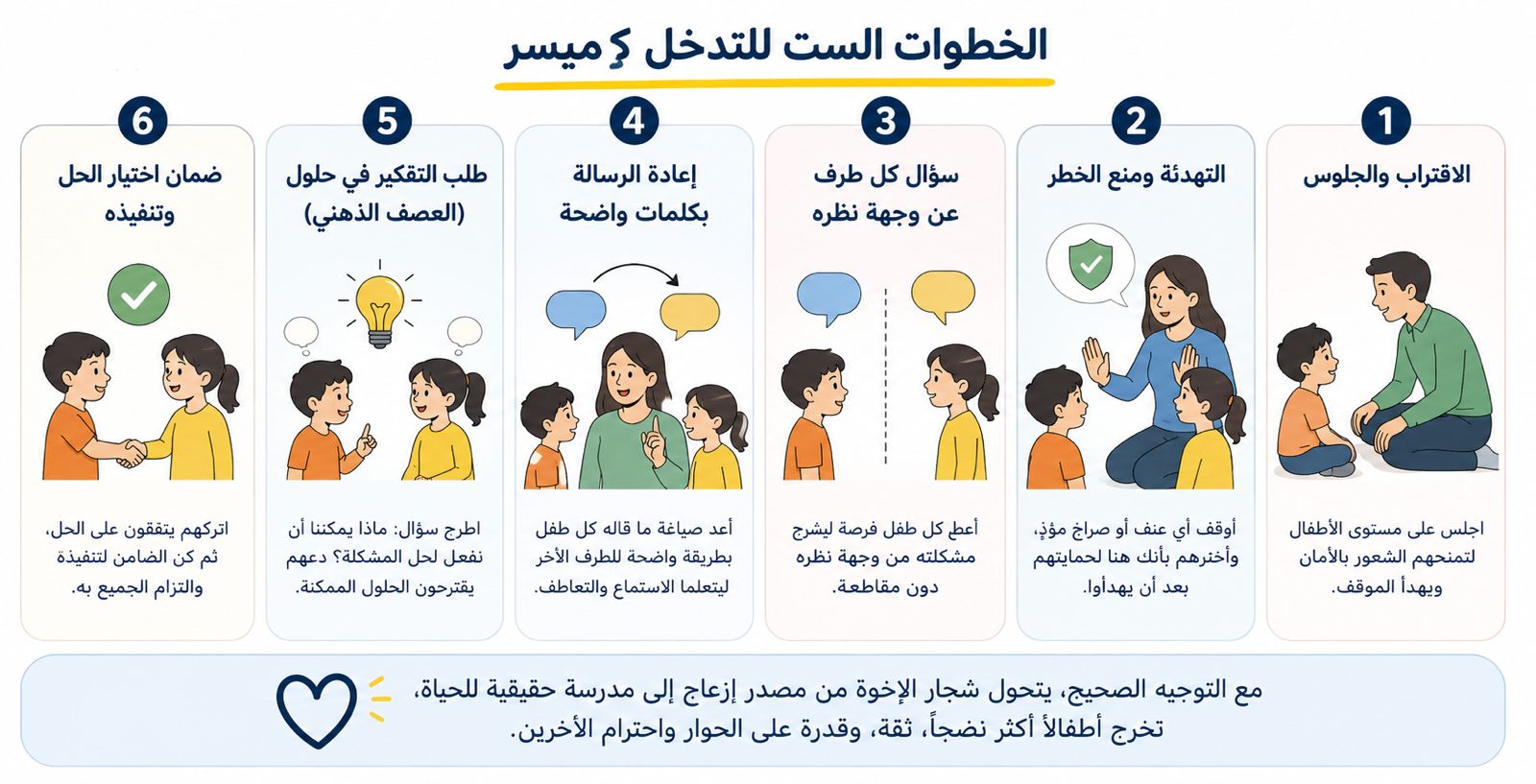
Here are six practical steps for intervention, inspired by Betsy Evans' book ** " You're Not My Friend Anymore "**, that help turn conflict into a lesson in emotional and social intelligence:
1. Approach and sit down
Get close to the children, get down to their physical level, and sit near them so that your eyes are at a similar level.
This closeness gives them a sense of security, helps to reduce tension, and makes them feel that the educator is there to listen and help, not just to judge.
2. Calming and preventing danger
Immediately stop any violent physical contact, hurtful shouting, or behavior that could lead to harm.
It can be said firmly and calmly:
"I am here to protect you, and I will listen to each and every one of you, but first we must calm down and stop hitting and shouting."
Some children may need a few moments to catch their breath before speaking, because a very angry child cannot think or express themselves clearly.
3. Asking each party for their point of view
Give each child enough space to explain the problem from their point of view, without interruption or ridicule from the other party.
It can be said:
**"I will listen to you first, then I will listen to your brother, and each of you will have your full opportunity."**
This step trains the child to organize his thoughts, formulate what bothered him, and identify the real reason for the dispute instead of just shouting or making accusations.
4. Rephrase each party's message in clear words.
Act as a mirror, and rephrase each child’s words in clear and neutral terms so that the other party can hear their sibling’s point of view.
For example, it can be said:
**“You, Ahmed, are angry because Khaled took the red cube without asking your permission, and you, Khaled, say that you thought Ahmed had finished playing with it. Did I understand you both correctly?”**
This step teaches children the skill of active listening, helps each party to see the situation from the other's perspective, and develops their ability to empathize and understand different feelings.
5. Asking for solutions - brainstorming
Ask the important question:
**“What solutions can we consider now so that the problem ends and everyone can continue playing?”**
Avoid imposing a solution directly, and do not adopt one solution from the beginning. Instead, give children a chance to think and suggest alternatives.
They might suggest:
* Role reversal.
Time management.
* Use a timer.
Playing together.
* Choose an alternative game.
* The game remains with its owner if it is private property.
* Postpone playing it until another time.
The goal is not to reach the ideal solution immediately, but rather to train children to think, compare, and choose the most suitable alternative.
6. Choosing and implementing the solution
Let the children agree, as much as possible, on a solution that suits them, even if it is a simple solution, such as dividing playtime by minutes or taking turns.
Then the role of the father or mother is to supervise the implementation of the solution chosen by the children, and to ensure that the parties adhere to it.
It can be said:
**"You agreed that each of you would play with the blocks for ten minutes, and I will help you stick to the time limit."**
When a child participates in choosing a solution, he is more willing to commit to it than to a solution imposed on him without participation or discussion.
## Encourage positive behavior after the conflict ends
It is important that our attention is not limited to moments of conflict, but that we also notice moments of cooperation, understanding and participation.
Tell them, for example:
* "I was pleased that you both listened to each other."
* "You did well when you found a solution yourselves."
* "It was nice to wait your turn."
* "I appreciate your apology and your attempt to rectify the situation."
* "Did you see how you were able to resolve the problem without hitting or yelling?"
Specific reinforcement helps the child learn the good behavior we want from him, and increases the likelihood of him repeating it in the future.
With continuous training, you will notice day after day the growth in your children's level of social maturity, and their ability to express themselves, negotiate, and understand each other without a constant need for adult intervention.
Next time the sounds of your children arguing rise up throughout the house, take a deep breath and don't let guilt overwhelm you.
Intervene when there is harm, guide when there is an opportunity to learn, and remember that you are not just managing chaos, but overseeing live social training.
In these small situations, children learn how to confidently demand their rights, respect the rights of others, disagree without losing the relationship, and reach solutions instead of remaining prisoners of the problem.