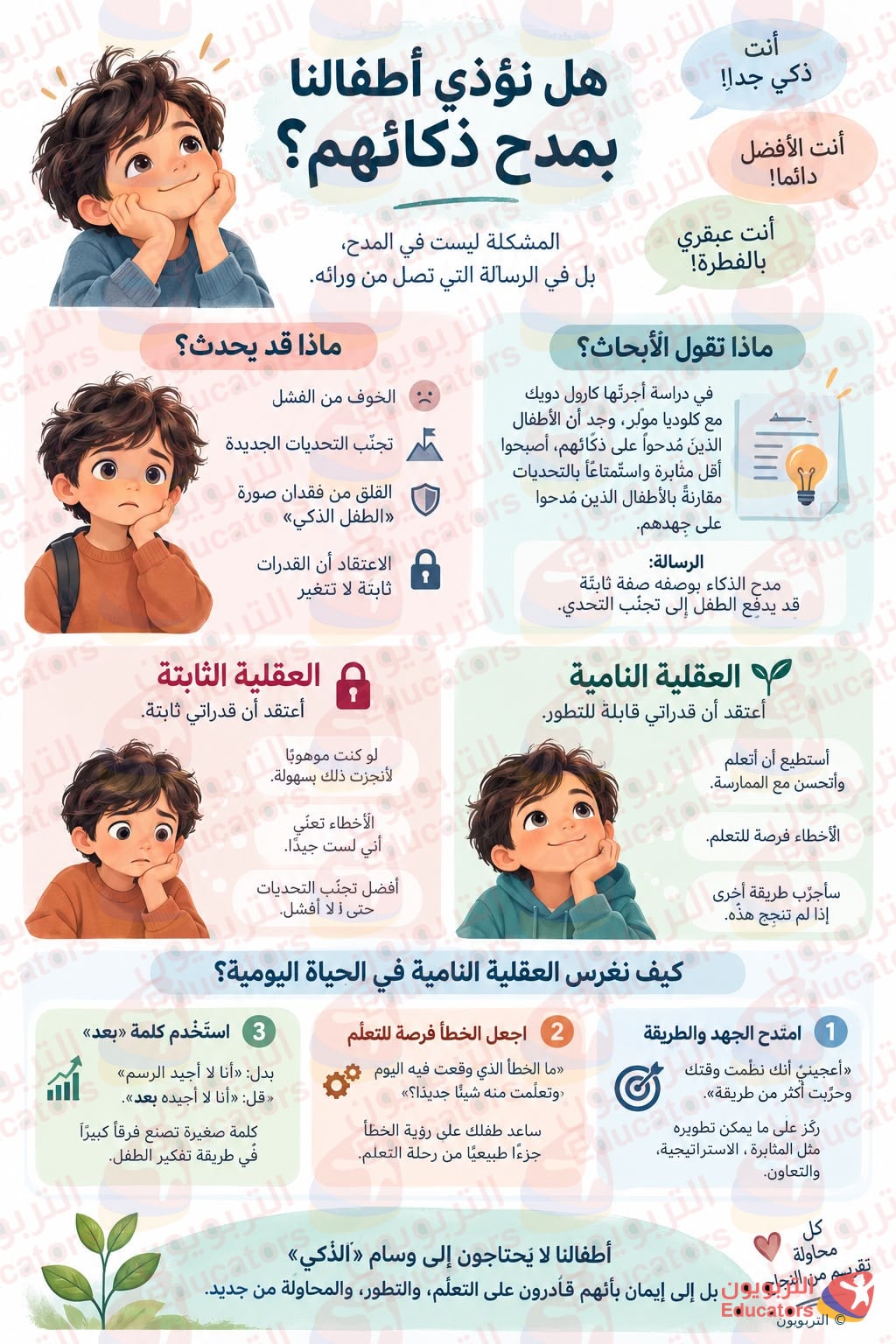
"You are a natural genius!", "You are one of a kind, my son, you are very clever!", "You are always the smartest and best of all!".
How many times have we repeated such phrases without realizing their impact?
We say it out of love and a desire to encourage, thinking that we are building our children's self-confidence. But praising intelligence in a way that makes a child feel that they must always be smart and superior may put them under a lot of pressure; they may hesitate to participate in a competition, or try a new activity, because they are not guaranteed to excel in it or maintain the image they are used to seeing themselves through.
Herein lies the problem: not in telling a child they are intelligent, but in making intelligence the constant explanation for their success, or instilling it in their mind as a fixed trait they must prove and maintain. When their self-image is linked to being "intelligent" or "always the best," they may become more concerned with protecting this image than with learning and experimenting, sometimes preferring not to try at all rather than try and fail.
This is what the research of psychologist Carol Dweck pointed out. In a study she conducted with Claudia Muller on fifth-grade children, they found that children who were praised for their intelligence after their success became, when faced with difficulty, less persistent and less enjoyable with the task, and their subsequent performance was weaker compared to children who were praised for their effort.
This leads to the concept of the Growth Mindset, which is linked to Dweck's research on how children respond to challenges and failure. This concept stems from the idea that human abilities are not entirely fixed, and that learning, practice, and using appropriate methods can help develop them.
This is related to the concept of neuroplasticity, which refers to the brain's ability to change, adapt, and form new neural connections through learning and experience.
Research into the developing mindset indicates that the way children respond to challenges depends not only on their innate talent, but is also influenced by the way they view their abilities and the difficulties they face.
The person with a fixed mindset
The child deals with intelligence and talent as fixed qualities that must be constantly proven; therefore, he may think that making an effort is evidence of his weakness, and he says to himself: “If I were really smart, I would have accomplished this without any effort.”
He may avoid challenges where he fears failure, or feels that any mistake threatens his image in front of others.
As for the person with a growth mindset
He views his current abilities as a starting point upon which to build. He does not see difficulty as evidence of inadequacy, nor does he consider mistakes as a final judgment on his abilities, but rather as an opportunity to learn what needs improvement and what other approach he can try.
Herein lies the essential question: How do we transform the "growth mindset" into a daily practice at home and at school?
Instilling this concept does not require grand slogans, but rather attention to our everyday words, and an environment that allows the child to try, make mistakes, and learn.
1. Praise the effort and the method, not just the intelligence.
Instead of saying:
"You are a genius because you got a perfect score."
We can say:
"I liked that you organized your time, reviewed your answers, and tried more than one method until you reached the solution."
And instead:
"You are the smartest kid in the class."
We can say:
"I noticed that you kept trying even though the question was difficult."
The goal is not to stop praising the child, but to make our praise linked to what he has done and what he can develop, such as diligence, perseverance, time management, choosing the appropriate method, and asking for help when needed.
And let's not forget the power of the word "yet." When a child says, "I don't understand the rules," or "I'm not good at drawing," we can say:
"You haven't mastered it yet."
This little word conveys the message from "I can't" to "I haven't learned it yet, but I can progress in it."
2. Turn mistakes into learning opportunities.
Instead of making a mistake a cause for shame or fear, help the child see it as a normal part of learning.
We can ask him a simple question:
"What mistake did you make today that you learned something new from?"
When a child sees their parents or teachers admitting their mistakes and learning from them without shame, they become more willing to try, even when success is not guaranteed the first time.
3. Teach the child to change their approach when they stumble.
Perseverance doesn't mean always trying the same thing. If a particular method doesn't work, help the child stop and think.
"This method didn't work, so what other method can we try?"
In this way, the child learns that success does not depend on persistence alone, but also requires reviewing the method, learning from mistakes, and trying new alternatives.
The next time your child accomplishes something or stumbles at an experience, remember that your words help him form an image of himself and his abilities.
Our children don't need to be told they're always the smartest, or to be portrayed as perfect children who never make mistakes. They need to be taught that their abilities can be developed, that making mistakes doesn't define their worth, and that difficulty isn't a sign of inadequacy.
Encourage your children to try, and teach them to ask themselves when they stumble: What can I try differently?
True confidence does not come from a child's belief that he will always succeed, but from his confidence that he can learn, develop, and try again.