
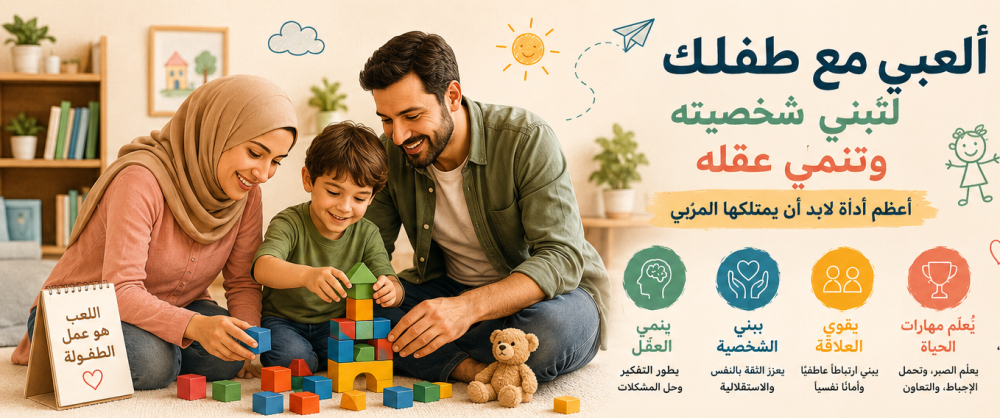
When you see your child engrossed in building a tower of blocks, or talking to his doll with complete seriousness, or reenacting a scene he saw at home, don't think he is wasting time. He is actually working; building himself, shaping his mind, and drawing the features of his personality.
The renowned psychologist Jean Piaget said: "Play is the work of childhood."
It was as if he wanted to say to every father and mother: Look at play as the real laboratory in which the child grows day by day.
Lev Vygotsky went even further when he said:
"In play, the child is always older than his age, and above his usual daily behavior."
He believed that play not only reflects growth, but also brings it about and accelerates it, especially when the child has someone he trusts and who plays with him.
Consider this: when your child tries to build a tower and it falls, then tries again, they are not just collecting blocks, but building a firm belief within themselves that says: "I am capable... and the attempt is worthwhile." And when you sit beside them and say: "Try again, you can do it," you become the inner voice of confidence that they will hear in their ear when facing the most difficult moments of their life in the future.
When your child takes on the roles of doctor, parent, or hero in role-playing games, they are practicing empathy and learning that others have feelings and thoughts different from their own. Research confirms that this type of play develops their cognitive and psychological skills, which are the foundation for social intelligence and successful relationships.
Every moment of loss in a game, every piece that doesn't fit, and every turn that doesn't yield the desired result, is a real training in **frustration tolerance**; the key skill that determines how a person deals with life's crises as they grow up.
What is the best toy to buy for our children?
Parents often ask me: "What is the best toy to buy for our child?"
And I always answer them: **You two.**
A father and mother who play with their child—even if it's just with a pen and paper, random blocks, or a story they invent together—are more effective than the most expensive smart toys on the market; because what the child is looking for is not material excitement, but **presence**; the conscious and complete presence of his parents, their attention, and their view of him as if he were the most important thing in the world.
Remember, play is the strong bridge between you and your child. Psychologists John Bowlby and Mary Ainsworth proved in their "attachment theory" that children who feel emotionally secure with their parents grow up to be more self-confident, better able to build healthy relationships, and more resilient in the face of life's challenges.
Playing together is one of the most powerful tools and shortest ways to build this emotional security.
In conclusion, my message to you both
Through play, we nurture, develop, teach, improve, and build lasting relationships.
Play with your child now, with what you have, just as you are.
Because your impact in that moment of play is much deeper than you can imagine!